How to Start a Landscaping Business
Quick Answer
To start a landscaping business, decide whether you will offer maintenance, installation or both, then check your state's contractor and pesticide licensing rules before you quote any job. Register the business, get a free EIN from the IRS, buy liability insurance, and price each job from labor, materials, equipment and overhead. Plan cash flow for slow seasons, since much landscaping work runs from spring to fall.
On this page
- What services will your landscaping business offer?
- Do you need a license to start a landscaping business?
- How do you register and set up a landscaping business?
- What equipment and insurance does a landscaping business need?
- How do you price landscaping jobs and plan for the seasons?
- How do you find clients and build a crew?
- Frequently Asked Questions
- Our Take
- Sources
Key Takeaways
- Maintenance (mowing, pruning, cleanups) and installation (planting, irrigation, patios) carry very different licensing rules.
- Some states license landscape contractors; California requires a state contractor license for landscaping projects of $1,000 or more in labor and materials.
- Most states require a license to apply pesticides, so check before offering weed or pest control.
- BLS reports a median wage of $18.82 an hour for landscaping and groundskeeping workers (May 2025), a benchmark for crew pay, not owner income.
- Work is seasonal in much of the country, so budget the winter months before you buy equipment.
Landscaping Business startup costs at a glance
- Estimated range
- $7,406 to $8,001
- Based on
- Owner-operator landscaping business (design, planting, light hardscape) in California, using a truck and trailer the owner already has. California requires a C-27 landscaping contractor license for jobs of $500 or more in labor and materials; other states differ.
What services will your landscaping business offer?
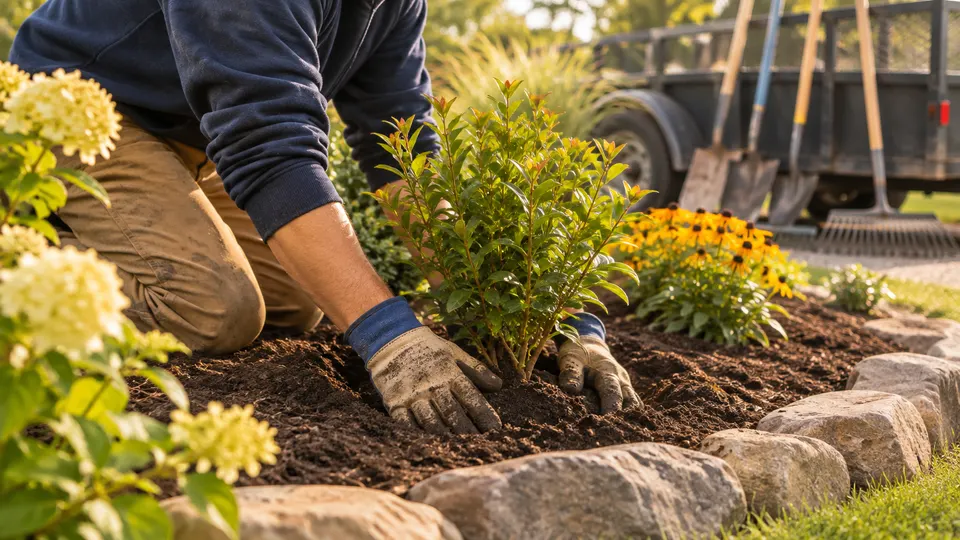
Start by choosing between two kinds of work, because the choice decides your licenses, equipment and pricing. Maintenance covers recurring tasks such as mowing, edging, pruning, mulching and seasonal cleanups. Installation covers projects: planting beds, sod, irrigation, lighting, drainage, patios and retaining walls.
Maintenance builds steady, repeat revenue with modest equipment. Installation brings larger tickets but more licensing, more risk and more working capital. If you mainly want to mow on a weekly route, our guide to starting a lawn care business focuses on that model.
The labor market is large. BLS counted about 1,299,200 grounds maintenance worker jobs in 2025, projects 5% employment growth from 2025 to 2035, and reports that about 20% of these workers are self-employed [1]. A self-employment share that high means many landscapers already work for themselves, so a clear specialty helps you stand out.
Do you need a license to start a landscaping business?
Usually you need a general business license from your city or county, and you may also need a state contractor license and a pesticide license depending on the work. The SBA explains that state, county and city governments set their own licensing and permit rules and tells owners to check each level [3].
Contractor licensing, California as an example. As of November 2026, California's Contractors State License Board (CSLB) says any construction project, including landscaping, valued at $1,000 or more in combined labor and materials requires a state contractor license, and so does any project that needs a permit or uses workers. Gardeners who maintain landscaping and are paid on a regular basis generally do not need the C-27 Landscaping license, but installing construction-related extras or doing repairs of $1,000 or more does require a license [2]. The CSLB lists irrigation systems, landscape lighting, patios, walkways, retaining walls, and plants and sod among the projects that need a license.
Other states draw these lines differently. Treat California as one example, not a national rule, and check your own state's contractor licensing agency.
Pesticide licensing. BLS notes that most states require licensing for workers who apply pesticides, and that states may also license workers who apply fertilizers [1]. If you plan to offer weed control or pest treatments, contact your state's department of agriculture or pesticide regulatory agency first. If you are not licensed yet, leave chemical treatments out of your service list.
How do you register and set up a landscaping business?
Registration can be done yourself, step by step, without paying anyone.
- Choose a business structure. The SBA notes that a sole proprietor's business assets and liabilities are not separate from personal ones, while an LLC protects owners from personal liability in most instances [4]. That liability point matters when you run heavy equipment on other people's property. Our LLC by state guide lists official fees, with detailed pages for states such as Florida and Texas.
- Register a business name if you will operate under a name other than your own.
- Get an EIN. The IRS says you never have to pay a fee for an EIN; you generally need one to hire employees or run a partnership or corporation [5].
- Get local and state licenses from the section above, plus any state contractor license.
- Open a business bank account and keep every receipt for fuel, equipment and materials.
- Buy insurance before the first job (see the next section).
Set aside money for taxes from the first payment. As of November 2026, the IRS lists the self-employment tax rate as 15.3%, and you file Schedule SE when net earnings from self-employment are $400 or more [6].
What equipment and insurance does a landscaping business need?
Buy for the services you sell, not for every job you might take. A maintenance-first starter list looks like this:
| Category | Examples | Notes |
|---|---|---|
| Mowing | Push or walk-behind mower, string trimmer, edger | Add a riding mower only when routes need it |
| Cleanup | Leaf blower, rakes, tarps, yard waste bags | Check local rules on yard waste disposal |
| Planting | Shovels, spades, wheelbarrow, pruners, hedge trimmer | Keep blades sharp and spares on the truck |
| Transport | Pickup or van, utility trailer, ramps, tie-downs | Confirm your auto policy covers business use |
| Safety | Eye and hearing protection, gloves, sturdy boots | Follow each tool's manual |
| Office | Phone, scheduling and invoicing app, mileage log | Track hours per job from day one |
Insurance protects you from the risks of working on other people's property with powered equipment. Common coverage includes general liability (property damage and injuries at a job), commercial auto for the truck and trailer, inland marine or equipment coverage for tools, and workers' compensation once you hire, under your state's rules. The CSLB even tells California homeowners to ask contractors for certificates of liability and workers' compensation insurance before work begins [2]. Premiums vary by state, payroll and services, so collect quotes from more than one licensed agent. Use our startup cost calculator to total your equipment list.
How do you price landscaping jobs and plan for the seasons?
Price each job from four parts: labor hours, materials (mulch, plants, sod, stone) with a markup, an equipment and fuel charge, and overhead such as insurance and marketing. Maintenance is usually quoted per visit or per month; installation is quoted per project with a written scope.
For a labor benchmark, BLS reports a median wage of $18.82 an hour for landscaping and groundskeeping workers in May 2025, and a median of $40,080 a year for all grounds maintenance workers in 2025 [1]. The median means half earned more and half less. These are wage ranges for employees, useful for setting crew pay, not a forecast of what an owner will earn.
Seasonality shapes the whole year. BLS notes that some grounds maintenance work is seasonal, available mainly in the spring, summer and fall [1].
Budget the slow months before you finance any equipment, because loan payments continue when the grass stops growing. Year-round contracts with monthly billing, fall and spring cleanups, and off-season services (where your climate allows) can smooth income.
How do you find clients and build a crew?
Your first clients will usually come from your immediate area, which also keeps drive time down. Practical starting points:
- Door-to-door routes: neighbors of current clients are the cheapest new clients to serve.
- Local listings and reviews: a free map profile with your service area and before and after photos of your own work.
- Property managers and homeowner associations: recurring maintenance contracts with written scopes.
- Seasonal offers: spring cleanup and fall leaf removal often lead to weekly maintenance.
Put every job in writing. The CSLB's checklist for California homeowners asks for a contract that states start and finish dates, plants and materials, cleanup and any follow-up maintenance plan, which is a useful model for any state.
When you hire, first decide whether helpers are employees or contractors. The IRS weighs behavioral control, financial control and the type of relationship [7]. A helper who uses your mowers, follows your route and works your hours looks more like an employee. Classify workers from the first hire using the IRS factors, and write down why you decided. For a written plan for your first year, the fill-in tables in our cleaning business plan template adapt well to a landscaping route.
Frequently Asked Questions
Do I need a license to mow lawns?
Usually only a local business license or tax registration. Regular maintenance is often exempt from contractor licensing; in California, for example, the CSLB says gardeners paid on a regular basis generally do not need a C-27 license. Applying pesticides is different and needs a license in most states.
Should a landscaping business be an LLC?
An LLC protects owners from personal liability in most instances, which matters when you work with heavy equipment on clients' property. It costs a state filing fee that varies by state; our LLC by state guide lists official fees.
How much do landscaping workers earn?
BLS reports a median of $18.82 an hour for landscaping and groundskeeping workers in May 2025. That is a median wage for employees, not a forecast of owner income, which depends on prices, route density and costs.
Is landscaping work year-round?
In many areas, no. BLS notes that some grounds maintenance work is seasonal, mainly in spring, summer and fall. Plan winter cash flow and consider off-season services that fit your climate.
Our Take
We think landscaping is a practical business to start because maintenance work needs modest equipment and the market already includes many self-employed workers. The sources we reviewed point to licensing as the biggest early trap: installation, irrigation, hardscape and pesticide work can need state licenses that plain mowing does not. Our advice is to start with maintenance, read your state's contractor and pesticide rules before adding installation or chemical treatments, and plan winter cash flow before financing equipment. Expand into higher-ticket projects once the license, insurance and pricing are in place.
Sources
- Grounds Maintenance Workers, Occupational Outlook Handbook. BLS, 2026.
- Fast Facts: Choosing the Right Landscaper. CSLB, 2025.
- Apply for licenses and permits. SBA, 2026.
- Choose a business structure. SBA, 2026.
- Get an employer identification number. IRS, 2026.
- Independent contractor (self-employed) or employee?. IRS, 2026.
This is general information, not legal, tax or financial advice. Fees, forms and rules change; confirm with the official agency or a licensed professional before you file. Spotted an error? Tell us.
Keep Reading

How to Start a Vending Machine Business
Start a vending machine business in the U.S.: register, open a sales tax account, check local licenses, vet sellers under FTC rules and sign a host first.

How to Start a Photography Business
How to start a photography business in the U.S.: pick a niche, set prices, get a free EIN, use contracts and copyright, and plan your first 90 days.
How to Start a Lawn Care Business
How to start a lawn care business: choose services, check pesticide licensing, register and get a free EIN, buy the right equipment, and build a dense route.

How to Start a Dropshipping Business
How to start a dropshipping business in the U.S.: pick products, vet suppliers, register, handle sales tax and meet the FTC rule on shipping times and refunds.

How to Start a Coffee Shop: Costs and First Steps
How to start a coffee shop: choose a format and location, plan the main cost categories, get health plan review and permits, register, and hire your staff.

How to Start a Clothing Brand From Zero
How to start a clothing brand from zero: pick a niche and production model, check your name with the USPTO, meet FTC label rules and set up sales tax.