How to Start a Vending Machine Business
Quick Answer
To start a vending machine business, choose what you will sell and where, register the business and get an EIN, open a sales tax account in your state, and check your city or county for a vending license. Buy machines only after you have a signed location agreement. If a seller also promises locations, the FTC Business Opportunity Rule gives you a disclosure document and seven days to review it.
On this page
- What does a vending machine business actually involve?
- How do you set up the business legally?
- How does sales tax work for vending machines?
- How do you buy machines without getting scammed?
- How do you find and keep good locations?
- What rules apply to the food you sell?
- What does a realistic first 90 days look like?
- Frequently Asked Questions
- Our Take
- Sources
Key Takeaways
- Locations come first. A machine without a signed host agreement is inventory sitting in a garage.
- Most states tax vending sales, and some require a decal or a posted notice on every machine.
- Cities and counties commonly regulate vending, so check local licensing before you place a machine.
- Sellers who promise to find you locations must give you a one-page FTC disclosure at least seven days before you pay or sign.
- Operators with 20 or more food machines must show calorie information under FDA rules.
Vending Machines startup costs at a glance
- Estimated range
- $9,000 to $35,970
- Based on
- A small route of 2 to 3 snack or drink machines, from 2 used machines at the low end to 3 new combo machines at the high end, each with a card reader. Austin, Texas is used as the permit example.
What does a vending machine business actually involve?
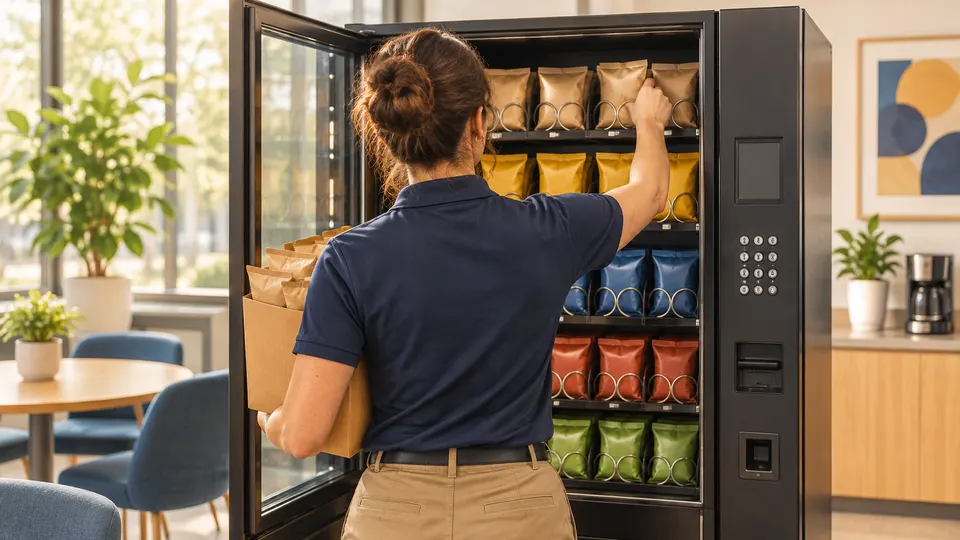
A vending business is a small retail route. You own or lease machines, place them in a host's building, keep them stocked, collect the money and pay the host whatever share you agreed on. The work is mostly driving, restocking, cleaning, fixing jams and tracking which products sell.
Most new operators pick one of three formats:
| Format | What it sells | What to plan for |
|---|---|---|
| Snack and soda machines | Packaged snacks, canned and bottled drinks | Refrigeration for drinks, a steady restock schedule |
| Combo machines | Snacks and cold drinks in one cabinet | Less floor space for the host, smaller selection |
| Bulk machines | Candy, gumballs, small toys | Low price per sale, many small locations |
A vending business is only as good as its locations, so treat finding hosts as the main job, not an afterthought. Before you spend money on equipment, spend a few weeks visiting offices, auto shops, apartment buildings, gyms and warehouses near you and asking who already serves them.
If you are still choosing between ideas, the business ideas page compares other low-staff options, and our guide to starting a business covers the steps every new owner faces.
How do you set up the business legally?
The legal setup for vending is the same core set of steps as any small business, plus a sales tax account and possibly a local vending license.
- Pick a structure. Many operators start as a sole proprietor or form an LLC to separate business and personal assets. The SBA explains the trade-offs between structures [1]. If you choose an LLC, our state guides walk through filing directly with the state, for example how to start an LLC in Texas and how to start an LLC in Florida.
- Get an EIN. The IRS issues an Employer Identification Number for free, and you can apply online [2]. Many suppliers and banks ask for one even if you have no employees.
- Open a sales tax account. Vending sales are usually taxable retail sales, and state rules differ (more on that below).
- Check local licenses. The SBA lists vending machines among the activities that counties and cities commonly regulate [3]. Call your city clerk or county licensing office and ask whether you need a vending license, a business license or a health permit for each machine.
- Get insurance. Most hosts will ask for proof of general liability coverage before you place a machine in their building.
You can see all of our state LLC guides on the LLC by state page.
How does sales tax work for vending machines?
Sales tax is where vending rules vary most, so read your own state's guidance before you set prices. Two official examples show how different the rules can be, as of November 2026:
- Colorado. Operators need an active sales tax license, must add each machine site as a non-physical location, and must apply for machine identification decals within 60 days of starting business. Every machine must display a decal, and the operator may include state and state-administered local tax in the price [4].
- Vermont. Vending sales fall under the meals tax rather than the sales tax, so snacks such as candy and chips are taxable even though they are exempt at a grocery store. One license can cover all of an operator's machines in the state, a sign must tell buyers that tax is included in the price, and some towns add a 1% local option tax [5].
Because most machines sell at round prices with tax built in, your real margin is the price minus the tax you owe, not the full price. Build that into your pricing from day one. Your state revenue department's website is the place to confirm whether food from machines is taxed in full, taxed at a reduced rate or exempt.
How do you buy machines without getting scammed?
Vending is one of the classic areas for business opportunity fraud, so slow down whenever a seller bundles machines with a promise of places to put them.
The FTC Business Opportunity Rule covers sellers who say they will provide customers, accounts or locations for the buyer [6]. Covered sellers must give you a one-page disclosure document at least seven days before you sign a contract or pay anything. The document lists the seller, relevant lawsuits, any cancellation or refund policy, whether an earnings claim is made, and references [7].
If a seller tells you how much a machine will earn, the rule requires a separate written statement headed "EARNINGS CLAIM STATEMENT REQUIRED BY LAW" [7]. If a seller will not put an earnings claim in writing, treat the claim as if it was never made. Call references that you find yourself, not only the ones on the seller's list.
Buying a used machine from a local operator, or a new machine with no location promise, does not trigger the same disclosure, so do your own checks: test the bill and card readers, ask for the refrigeration history and confirm that replacement parts are still available.
How do you find and keep good locations?
Good hosts have steady foot traffic, few nearby food options and someone who will answer when a machine breaks. Small and mid-size workplaces, repair shops, laundromats and apartment common rooms are common starting points for new operators.
When you pitch a host, bring a one-page proposal: the machine size, the products you plan to stock, how often you will restock, how to report a problem and what share of sales, if any, the host receives. Put the agreement in writing, including who pays for electricity, how either side can end it and how much notice is required.
Keep locations by being reliable. Restock before slots run empty, fix jams quickly and rotate slow sellers out. A simple spreadsheet that tracks sales by slot for each machine tells you what to reorder and which locations are worth keeping.
What rules apply to the food you sell?
Packaged snacks and sealed drinks usually need only a sales tax account and any local vending license, but fresh or perishable food can bring in a health department permit. Ask your local health department before you stock sandwiches, salads or anything that needs temperature control.
At the federal level, the FDA requires operators who own or operate 20 or more vending machines to disclose calorie information for food sold from them, subject to certain exemptions. Operators with fewer than 20 machines can volunteer to be covered [8]. If you plan to grow past 20 food machines, set up calorie signs or choose products with front-of-package calorie labels early.
What does a realistic first 90 days look like?
There is no official timeline for opening a vending route, but a sample plan helps you order the work so that money goes out only after a location is secured.
Startup costs depend on whether you buy new or used machines, how many you start with and what you stock. The cost summary on this page lists sourced estimates when they are available, and the startup cost calculator lets you plug in your own quotes. Keep enough cash for the first restock and for repairs, because a machine that sits broken also costs you the location.
If you like the idea of retail without a storefront, compare this route with starting a coffee shop, which needs far more staff and space, and browse the resources page for official links in one place.
Frequently Asked Questions
Do I need a license to own a vending machine?
Usually yes, in some form. You will need a state sales tax account in most states, and many cities and counties require a business or vending license for each machine. The SBA lists vending among the activities local governments commonly regulate, so check with your city and county before you place a machine.
Do I have to charge sales tax on snacks from a vending machine?
In many states, yes, even when the same snacks are tax-free at a grocery store. Vermont, for example, taxes vending sales under its meals tax. Check your state revenue department's vending guidance, because rates and exemptions differ.
Should I buy a vending package that comes with locations?
Only after you read the FTC disclosure document, wait the full seven days, check references you found yourself and get any earnings claim in writing. If the seller skips any of those steps, the FTC calls that a red flag.
Do I need to post calorie information?
The FDA rule applies to operators with 20 or more vending machines that sell food. Smaller operators are not required to comply but may register voluntarily.
Our Take
We think vending suits people who like routes, spreadsheets and small repairs more than people looking for a hands-off business. The official sources point to three checks that new operators skip most often: the local vending license, the state's specific sales tax treatment of machine sales, and the FTC disclosure when a seller bundles locations with machines. We would line up one signed host agreement before buying the first machine, start with a small number of machines you can service yourself, and expand only after a few months of sales records show which locations hold up. Earnings vary widely by location, so treat any seller's revenue figures as claims to verify, not forecasts.
Sources
- Choose a business structure. U.S. Small Business Administration, 2026.
- Get an employer identification number. Internal Revenue Service, 2026.
- Apply for licenses and permits. U.S. Small Business Administration, 2026.
- Sales and Use Tax Topics: Vending Machines. Colorado Department of Revenue, 2026.
- Vending Machines. Vermont Department of Taxes, 2026.
- Selling a Work-at-Home or Other Business Opportunity? Revised Rule May Apply to You. Federal Trade Commission, 2026.
- Bogus Business Opportunities. Federal Trade Commission, 2026.
- Vending Machine Labeling Requirements. U.S. Food and Drug Administration, 2026.
This is general information, not legal, tax or financial advice. Fees, forms and rules change; confirm with the official agency or a licensed professional before you file. Spotted an error? Tell us.
Keep Reading

How to Start a Photography Business
How to start a photography business in the U.S.: pick a niche, set prices, get a free EIN, use contracts and copyright, and plan your first 90 days.
How to Start a Lawn Care Business
How to start a lawn care business: choose services, check pesticide licensing, register and get a free EIN, buy the right equipment, and build a dense route.

How to Start a Landscaping Business
How to start a landscaping business in the U.S.: pick services, check contractor and pesticide licenses, register, insure, price jobs and plan for the seasons.
How to Start a Dropshipping Business
How to start a dropshipping business in the U.S.: pick products, vet suppliers, register, handle sales tax and meet the FTC rule on shipping times and refunds.
How to Start a Coffee Shop: Costs and First Steps
How to start a coffee shop: choose a format and location, plan the main cost categories, get health plan review and permits, register, and hire your staff.
How to Start a Clothing Brand From Zero
How to start a clothing brand from zero: pick a niche and production model, check your name with the USPTO, meet FTC label rules and set up sales tax.