How to Start a Cleaning Business
Quick Answer
To start a cleaning business, pick a market (homes or commercial buildings), register the business and get a free EIN, then check the licenses your state, county and city require. Add liability insurance, write a price sheet and a cleaning checklist, buy starter supplies, and land your first clients through referrals and local listings. Most owners can start small, from home, with one vehicle.
On this page
- What kind of cleaning business should you start?
- How do you register a cleaning business?
- What licenses and insurance does a cleaning business need?
- How do you price cleaning jobs?
- What are your first 90 days before the first paid clean?
- How do you find your first cleaning clients?
- When should you hire your first cleaner?
- Frequently Asked Questions
- Our Take
- Sources
Key Takeaways
- Decide first between residential and commercial cleaning; it shapes your hours, pricing, insurance and how you find clients.
- Registration is mostly paperwork: a business structure, a free EIN from the IRS, and any state and local licenses.
- Cleaning chemicals bring safety duties once you hire, including labels, safety data sheets and training.
- BLS reports a median wage of $17.71 an hour for janitors and building cleaners (May 2025); that is a range point for employees, not a promise of owner income.
- Price by the job from a written checklist, then track time on every visit so you can correct prices early.
Cleaning Business startup costs at a glance
- Estimated range
- $2,046 to $2,690
- Based on
- Solo residential house cleaning service; the owner uses a vehicle they already own, so no vehicle purchase is included. Figures are first-year costs paid at or near launch.
What kind of cleaning business should you start?
Start by choosing who you will clean for, because almost every later step depends on it. Residential cleaning serves households: recurring house cleaning, move-in and move-out cleans, and deep cleans. Commercial cleaning, often called janitorial work, serves offices, shops, clinics and other buildings under a service contract.
The two markets run on different schedules. The Bureau of Labor Statistics notes that because office buildings are often cleaned while they are empty, many cleaners work evening hours [1]. Residential work is usually scheduled around the household's day.
Pick one market for your first year and build your checklists, prices and marketing around it. Splitting your attention across both usually means two sales processes and two sets of supplies before you have steady revenue. You can also narrow further: move-out cleans for property managers, post-construction cleanup, or recurring cleaning for small offices. If you are still comparing options, our business ideas list and the home services guides cover related trades such as lawn care.
How do you register a cleaning business?
Registration is mostly paperwork, and you can do every federal step yourself without paying a service.
- Choose a business structure. A sole proprietorship is the simplest, but the SBA notes that its business assets and liabilities are not separate from your personal ones. An LLC protects owners from personal liability in most instances [2]. Our LLC by state guide lists each state's filing office and official fee; see Texas for a full walkthrough.
- Register your business name with your state or county if you operate under a name other than your own.
- Get an EIN from the IRS. The IRS says you never have to pay a fee for an EIN and issues it online immediately when the application is approved. You generally need one to hire employees or to run a partnership or corporation [4]. If you form an LLC, register with the state first.
- Open a separate business bank account so job income and supply costs are easy to track at tax time.
Plan for taxes from the first job. As of November 2026, the IRS lists the self-employment tax rate as 15.3% (12.4% Social Security plus 2.9% Medicare), and you must file Schedule SE if your net earnings from self-employment are $400 or more [5]. Set aside part of every payment.
What licenses and insurance does a cleaning business need?
Most cleaning businesses do not need a special federal license. The SBA explains that states, counties and cities set their own licensing and permit rules, and tells owners to research their own state, county and city regulations and to check local government websites [3]. In practice, that usually means a general business license or tax registration from your city or county, plus state tax registration if your state taxes cleaning services. The same SBA page notes that zoning rules can apply to home-based businesses, so check before you store supplies or park a work vehicle at home.
BLS also reports that no license is required to work as a janitor or building cleaner, though certification can demonstrate competence [1]. That makes your own proof of reliability more important.
Insurance is where clients look first. Common coverage for a cleaning business includes:
| Coverage | What it is for | Who usually asks |
|---|---|---|
| General liability | Damage to a client's property or injuries at a job | Homeowners, property managers, every commercial client |
| Janitorial (fidelity) bond | Theft claims against you or your workers | Commercial clients, some households |
| Commercial auto | Driving to jobs with supplies | Your insurer, if a personal policy excludes business use |
| Workers' compensation | Employee injuries | Your state, once you hire (rules vary by state) |
Prices for these policies vary by state, payroll and claims history, so get quotes from more than one licensed agent. Your state's workers' compensation rules decide when coverage becomes mandatory.
How do you price cleaning jobs?
Price by the job from a written checklist, not by guesswork, and time every visit so you can correct prices early. Most new owners quote either a flat price per visit (based on rooms, square footage and condition) or an hourly rate. A flat price is easier for clients to accept, but only works if your checklist is fixed and you know how long each task takes.
Build each quote from four parts:
- Labor: the hours the job takes multiplied by what you need to pay yourself or a cleaner.
- Supplies: chemicals, cloths, mop heads and vacuum bags used up on the job.
- Overhead: insurance, fuel, phone, software and marketing, spread across your expected jobs.
- Profit: a margin on top, so the business can replace equipment and survive slow months.
For a wage benchmark, BLS reports a median pay of $36,840 a year, or $17.71 an hour, for janitors and building cleaners in May 2025; the median means half earned more and half earned less [1]. Those figures cover employees and exclude self-employed workers, so treat them as a reference point for what you will pay a cleaner, not as a forecast of what an owner earns. Use the startup cost calculator to add up your own supply and equipment list before you set prices.
What are your first 90 days before the first paid clean?
A realistic plan spreads setup across about three months, so that registration, insurance and marketing are ready at the same time.
What goes in a starter supply kit?
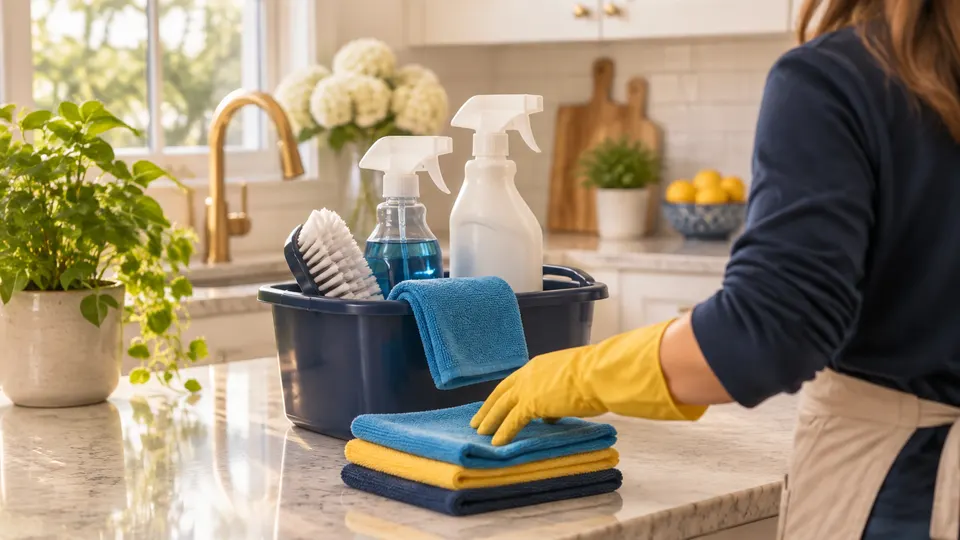
Buy only what your checklist uses, then add tools as real jobs show you what is missing. A typical residential starter kit looks like this:
| Category | Examples | Tip |
|---|---|---|
| Chemicals | All-purpose cleaner, glass cleaner, bathroom cleaner, degreaser | Keep the safety data sheet for each product |
| Cloths and pads | Color-coded microfiber cloths, scrub pads, sponges | Separate colors for kitchens and bathrooms |
| Floors | Vacuum, mop, buckets, replacement mop heads | Check bags and filters before each job |
| Carrying | Caddies, spray bottles with printed labels | Label every refilled bottle |
| Protection | Gloves, eye protection where product labels call for it | Read each product label before first use |
| Office | Phone, scheduling and invoicing app, receipt folder | Log mileage from day one |
Commercial cleaning often needs heavier equipment, such as a commercial vacuum or a floor machine, so price the equipment into your first bids instead of buying it before you have a contract. The startup cost calculator linked above can help you total that list.
Use the practice cleans in days 46 to 60 well. Clean your own home or a friend's with your written checklist and a timer, room by room. Those times become the basis of your price sheet. If you want a written plan to go with the timeline, our cleaning business plan template follows the SBA's plan sections and has fill-in tables for services, pricing and first year targets.
How do you find your first cleaning clients?
Your first clients will most likely come from people who already know you and from local search. A few low-cost channels to start with:
- Referrals: tell friends, neighbors and former coworkers that you are taking clients, and ask happy clients to pass your name along.
- Local listings: a free business profile on map and review platforms, with your service area, hours and photos of your supplies and checklist.
- Property managers and real estate agents: move-out and move-in cleans recur with every tenant change.
- Small offices: for commercial work, walk through, measure the space and submit a written bid with a clear scope.
Show the scope in writing every time. A one-page checklist that lists what is and is not included (inside the oven, inside the fridge, windows) prevents most disputes.
Keeping clients matters as much as finding them. Recurring weekly or biweekly clients give you a predictable schedule, which makes it easier to plan routes, buy supplies and decide when to hire. Send the same cleaner when you can, confirm visits a day ahead, and ask for feedback after the first two or three cleans while problems are still easy to fix. When you raise prices, give recurring clients written notice and explain what changed.
When should you hire your first cleaner?
Hire when you are turning work away or when one person cannot finish the booked jobs in a normal week. Hiring changes your duties in three ways.
First, decide whether workers are employees or independent contractors. The IRS says the answer depends on how much control the business has over what the worker does and how the job is done, weighed across behavioral, financial and relationship factors [6]. A cleaner who follows your checklist, uses your supplies and works your schedule looks more like an employee.
Second, chemical safety becomes a formal duty. OSHA's Hazard Communication standard requires employers to have labels and safety data sheets for hazardous chemicals their workers use, and to train workers to handle them safely [7]. Keep a binder or shared folder with the safety data sheet for every product you buy.
Third, you take on payroll tax withholding and, under your state's rules, workers' compensation coverage. Adding one employee changes your paperwork more than any other step in growing a cleaning business.
Frequently Asked Questions
Do I need a license to start a cleaning business?
Usually you need a general business license or tax registration rather than a cleaning-specific license. The SBA says licensing depends on your state, county and city, so check each level's official website before your first paid job.
Can I start a cleaning business from home?
Yes, many owners run the office side from home and travel to clients. The SBA notes that zoning rules can still apply to home-based businesses, so confirm with your city or county before storing supplies or parking a work vehicle there.
Should my cleaning business be an LLC?
An LLC protects owners from personal liability in most instances, while a sole proprietor's business and personal liabilities are not separate. Filing an LLC costs a state fee that varies by state; our LLC by state guide lists the official fees.
How much do cleaners earn?
BLS reports a median of $36,840 a year ($17.71 an hour) for janitors and building cleaners in May 2025. That is a median for employees, not a forecast for owners, whose results depend on prices, hours and costs.
Our Take
We think a cleaning business is one of the more approachable home service businesses to start, because the federal paperwork is free or low cost and the skill can be learned on the job. The sources we reviewed point to the same weak spots: unclear licensing at the local level, underpriced quotes and the jump in duties that comes with the first hire. Our advice is to pick one market, write the checklist before the first quote, time every job for the first few months, and call your city or county licensing office before you advertise. Growth can wait until the prices are right.
Sources
- Janitors and Building Cleaners, Occupational Outlook Handbook. BLS, 2026.
- Choose a business structure. SBA, 2026.
- Apply for licenses and permits. SBA, 2026.
- Get an employer identification number. IRS, 2026.
- Independent contractor (self-employed) or employee?. IRS, 2026.
- Hazard Communication. OSHA, 2026.
This is general information, not legal, tax or financial advice. Fees, forms and rules change; confirm with the official agency or a licensed professional before you file. Spotted an error? Tell us.
Keep Reading
How to Start a Vending Machine Business
Start a vending machine business in the U.S.: register, open a sales tax account, check local licenses, vet sellers under FTC rules and sign a host first.

How to Start a Photography Business
How to start a photography business in the U.S.: pick a niche, set prices, get a free EIN, use contracts and copyright, and plan your first 90 days.
How to Start a Lawn Care Business
How to start a lawn care business: choose services, check pesticide licensing, register and get a free EIN, buy the right equipment, and build a dense route.

How to Start a Landscaping Business
How to start a landscaping business in the U.S.: pick services, check contractor and pesticide licenses, register, insure, price jobs and plan for the seasons.
How to Start a Dropshipping Business
How to start a dropshipping business in the U.S.: pick products, vet suppliers, register, handle sales tax and meet the FTC rule on shipping times and refunds.

How to Start a Coffee Shop: Costs and First Steps
How to start a coffee shop: choose a format and location, plan the main cost categories, get health plan review and permits, register, and hire your staff.